latest News

Mindful Running with Michael Sandler
Some readers may know that Michael Sandler is one of the reasons Xero Shoes exists.Back in the Summer of 2009 he said, "You know, if you treated this hobby of making barefoot sandals like a business -- and built a website -- I'd put you in a book that I'm writing called Barefoot Running."To make a long story short, 24 hours later I had a website ;-)Well, Michael has a new program called "The Mindful Running Program" and he interviewed me for it.Some of what we talked about: Using "mental rehearsal" (not visualization) to prepare for races How barefoot running can become instant meditation The 4 "neurological types" of barefoot runners, and what each one needs in order to improve And, then, on a personal note:What happens in my mind when I'm running a 100m, or when I was competing as an All-American gymnast... or when I was captured and shot at in Tienanmen Square in 1989!Click here to check out the interview, and leave a comment after you hear it.

Who will run the first 1:59 marathon?
Dennis Kimetto shattered the marathon world record when he ran 2:02:57 in Berlin.But how fast can we really go over a 26.2 mile course?2:01?2:00?Faster?Well, long-time distance running guru, Phil Maffetone thinks 1:59 is do-able. VERY do-able.And he also thinks that the person who sets that record will be running barefoot!Frankly, we hope he (and, I know it sounds sexist, but it'll be a "he") opts for a tiny bit of protection and wears a pair of Xero Shoes!Phil's book has some fascinating info about the sub-2 marathon, and even things that might help you run faster than you thought you could. And you'll find out why he thinks the sub-2 wil be run without shoes.Check it out on Amazon -- http://www.amazon.com/Sub-Two-Hour-Marathon-Within-Runners-Training/dp/1629148172And to show you something beautiful, look at this slow-mo video of Dennis. Even with a 10mm drop in his shoes, he's a serious mid-foot strike runner. I'd love to get Dennis in a pair of Amuri Cloud ;-)

Can Xero Shoes find the love of your life?
Google alerted us to this Xero Shoes-based "Missed Connection". Can you help them un-miss?I can't wait until we have our first Xero Shoes inspired romance!
National Runner Survey 2014
Calling all RUNNERS!What motivates you to run? What is your favorite race distance? How often do you run?You are being invited to participate in Running USA’s National Runner Survey, a comprehensive survey to assess the demographics, lifestyle, attitudes, habits, and product preferences of the running population nationwide.The National Runner Survey is easy to access and available online. All responses are completely anonymous and confidential.Don’t miss this opportunity to join other runners nationwide!To access the survey, click here:https://www.research.net/s/NRS15_XeroShoesSelect Xero Shoes as the organization that invited you to participate.The survey is open until December 15, 2014.
Can You Cure Plantar Fasciitis with Barefoot Running?
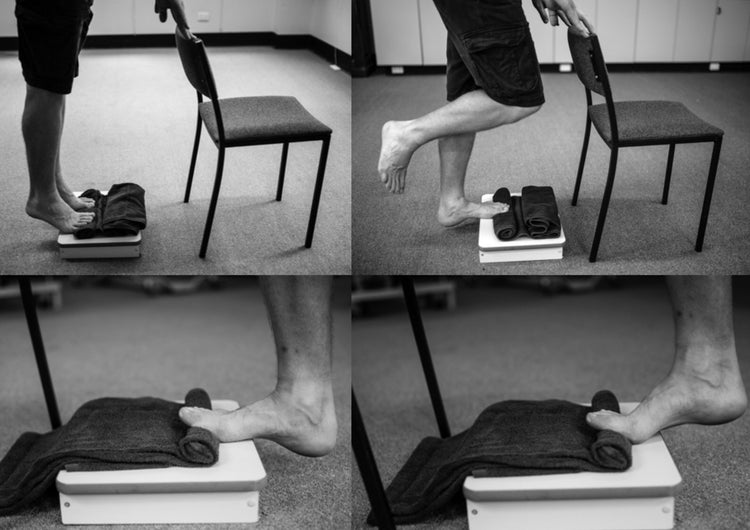
A new study by Michael Rathleff and his colleagues offer a new approach for treating plantar fasciitis: strength training. More specifically working on foot and calf strength.Click here to read about the research. I can't say I'm surprised by this. It's often the case that gaining strength cures many movement-related problems. But what's most interesting to me is that this research suggests why many barefoot runners report an elimination of plantar fasciitis. Specifically, when you look at the report about the research and read the recommendations for the type of strength training to do, you'll see that the movements are very similar to what you do when you run with a forefoot or midfoot landing.Running this way "pre-loads" your plantar fascia, positioning your foot in a strong position when it contacts the ground, rather than being in the pre-streteched and weak position that you're in when you heel strike, especially in a highly padded shoe.The content of this post does not constitute and is not intended to be a substitute for professional medical advice, diagnosis or treatment. Always seek the advice of a physician or other qualified health provider with any questions or concerns you may have about your health or a medical condition.

24 Hour Barefoot Running World Record
If you bump into someone who opines, "You can't run in bare feet!" show them this.Andrew Snope ran 131.43 miles, barefoot, in 24 hours!Yup. Ran for 24 hours (with just a few bathroom breaks). Did it barefoot.And if that same opinionated person counters with, "Yeah, but the world record is 188.59 miles from a guy wearing shoes," you can reply with, "But Andrew's only been a runner for 3 years, and he wasn't trying to beat the record. Geez!"We say a big congrats to Andrew and can't wait to see what he does next!
A video response about whether barefoot is BS
In another post, I gave my LONG response to Marc Lindsey's "article" (it may be a "native advertisement, sponsored by Brooks shoes) about whether barefoot running is BS or not.Here's a quick video response to go with that post. Enjoy, and share your thoughts, below.
Is barefoot running really BS?
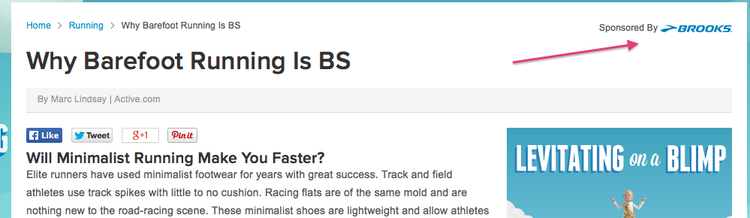
Marc Lindsay recently posted what I'm sure he thinks is a scathing critique of barefoot running at Active.com called "Why Barefoot Running is BS." Sadly, it's not the well-researched, well-considered investigation I think he believes it to be. In fact, given that the top of the article clearly says "Sponsored by Brooks," one has to wonder if this anti-barefoot running article isn't just a piece of shoe industry propaganda. In fact, check out this amazing expose on "native ads" by John Oliver Now it may be that Marc is completely unaffected by his sponsor, but even if that were the case, his article is such an incredible demonstration of faulty reasoning and bad logic, that I found myself compelled to write a rebuttal that's longer than his original article! You can read the article and come back here to read my response, or you can just start here and I'm sure you'll get the picture ;-) Marc,Before I address specific points in your article, I have to ask: is this actual reporting, or a “native ad” for which you were paid to write an anti-barefoot article by the shoe company Brooks? I ask because in the upper right corner, opposite the breadcrumbs, I see “Sponsored by Brooks.” Let me start, now, with a few broad strokes. You begin your article with a false equivalence. Ignore for a moment that if research showed that naked running did improve running performance, contrary to your assertion, you would have a rash of Naked 5k races and whole new nude Olympics. Comparing your example of “you heard naked is better,” to “you heard barefoot is better” is an inaccurate comparison, since the claims about barefoot aren't as unsubstantiated as you would like to believe. You don't recognize this, though, due to a number of other errors in your reasoning. For example, you repeatedly conflate barefoot and minimalism. This is common in both anti-barefoot running articles, advertisements for minimalist footwear, and running research. However, no accomplished barefoot runners or coaches that I know have ever stated that running in minimalist shoes is the same as running barefoot. You've even conflated Tarahumara runners with both minimalism and barefoot. Even though the Tarahumara often do run barefoot, and are tightly linked to the barefoot idea, the reality is that they spend more time in huaraches than they do barefoot. And the huaraches they wear are thicker, heavier, and stiffer than any running shoe you've ever seen. They're practically rubber bricks. Why the Tarahumara are interesting is not their footwear, or lack thereof, but their running form, which we'll address in a moment. As a minimalist footwear seller, I'm the first to admit that even running in Xero Shoes (@xeroshoes), which are just a few millimeters of rubber between you and the ground, is not identical to being barefoot — while a pilot study showed that runners in Xeros have identical biomechanics compared to when they're barefoot, feeling the same surface — the rubber — with each step is not the same as the feedback you get from stepping on a continually varying surface. Next, you make the common mistake of claiming that a lack of scientific evidence for barefoot running's value is proof that there is no value. This is another common error in logic. Up until very recently, there was no proof that the Higgs Boson existed, but that didn't mean it didn't exist. There were valid reasons to think it did, and once adequate research was performed, it was discovered. Similarly, the arguments made in favor of running barefoot — valid hypotheses about physics and physiology made by well-respected researchers as well as by long-time practitioners — simply haven't been well-tested. A careful look at most barefoot research, both pro- and con-, shows common problems with study design — small samples sizes, poor control groups, poor sample selection, and potential bias since most studies are funded by companies with a vested interest in the outcome. I've seen studies where the “barefoot runners” being studied are people that I know — people who have never run more than a few hundred yards on a paved road without shoes. Backing up to conflating barefoot and minimalist and thinking them equal, let's go back in time a few years. If you look at the barefoot movement from 2009 until now, you see that the shoe companies began by dismissing any possible value of barefoot running at a time when they had no product to sell into the barefoot market. Nike, of course, is an exception since they had the Free available. Shockingly (and I say that with 100% pure sarcasm), once the shoe companies had products they felt were “closer to barefoot,” the conversation changed. The major shoe companies adopted the language of barefoot running, and the claims that barefoot runners and researchers have made, applying them to products that no barefooters endorse. In fact, most minimalist shoes are so far from being genuinely minimalist, they've rendered the term meaningless. If you look at the ACSM's suggestions — zero drop, minimal stack height, no arch support, wide toe box — and go look at shoes sold as “minimalist,” you'll be hard pressed to find any that fit the bill. Instead you'll find products that have up to 1” of padding, narrow toe boxes, narrow midfoot areas with significant arch support… or some combination thereof. So, your repeated criticism of minimalist as if it were the same as barefoot, and vice versa, is moot. By the way, an example of this conflation is when you refer to the Vibram lawsuit and then say, “And the plaintiff wasn't alone in his claims,” and then quote the American Podiatric Medicine Association's position about barefoot running. The APMA's comments are totally unrelated to the Vibram case, and are about running barefoot, not in minimalist shoes. More, referring to the APMA is merely an appeal to authority. That is, just because they're an official organization it does not, because of their position of authority, mean their opinions are factually accurate. Even the seemingly obvious statement that running barefoot increases your chances of a puncture wound is baseless and incomplete. For that statement to have merit, there would have to be data about puncture-related injuries in shod vs. barefoot runners presented in a meaningful fashion (e.g. it's meaningless if the actual data shows a 100% increase because there was 1 reported puncture would in a shod runner, and 2 from barefoot runners). Next, looking at the claims of barefoot running, you've fallen into another familiar trap, a straw-man argument about the benefits of barefoot. I've yet to find a barefoot runner or researcher who claimed that barefoot was more efficient than shod running. Yet, somehow this “claim” has made the news, often when research done by shoe company-sponsored labs seemingly shoot it, and the straw-man, down by apparently showing that barefoot runners have a higher VO2 than shod runners. Ignoring for a moment that less efficiency does not equate to decreased performance and that most casual runners would never notice the statistically tiny difference in VO2, when you look at the “barefooters are less efficient” studies, you find that it's people who are new to barefoot that are less efficient. Competent barefoot runners are equally efficient. In other words, and not surprisingly, someone who is learning a new way to move uses more energy than when they use their habitual movement patterns. Tangentially this is another hole you've fallen into, where most media also stumbles: not evaluating the source data. Pete Larson, of runblogger.com, has been the most thorough at highlighting the disparity between actual research results and the way those results are misrepresented by the media. Sadly, once one media outlet says, “Barefoot is bad for you” by misunderstanding a study, that meme spreads like, well, Internet memes spread — unchecked and unquestioned. Next, you make a familiar mistake by looking at injury rates out of context. Barefooters do make the claim that running barefoot is safer, that you're less likely to get injured without your shoes. Before you scream from the rooftop that “barefoot running will hurt you,” by quoting statistics, you need to consider three things: the current rate of shod running injuries; the causes of what are called “barefoot related injuries;” and the simple claim by those injured that barefoot running was the cause. First, you can't hold barefoot to a different standard than shod running. Fifty percent of shod runners and 80% of shod marathoners get injured every year. And this number hasn't changed since the introduction of modern running shoes in the early 70's. In over 40 years, there has never been one study showing that modern running shoes are in any way better for you. Not one study showing that a particular style or model of padded, motion-controlled shoes reduces injuries or even improves performance compared to another. Considering that the running shoe business is a multi-BILLION dollar industry, you would think it in the best interest of any shoe company to prove that their latest “improvement” in padding, “energy-return” (i.e. “sucking less energy out of you”), or pronation control was reliably proven to be better than any other product. If well-designed research showed actual benefits of one shoe over another, that would be worth hundreds of millions of dollars. So the fact that there's no research showing any such thing seems to suggest a lack of “there” there. So the fact that barefoot runners get injured is meaningless unless you compare the injury rate to shod runners. Unfortunately that doesn't mean you simply count the number of barefoot runners who've gotten injured, because this leads to another confusion demonstrated by your article. No knowledgeable barefoot runner or coach thinks that the value of running without shoes comes from simply removing your shoes. None in that group suggest that merely removing your footwear is a panacea or solution to all running problems. What we say is that running barefoot is a way, perhaps the best way, to make changes in your running form that lead to fewer injuries and a reduction of impact forces. The specifics of this form tend to include: landing with the foot closer to or under the center of mass, with a forefoot or mid-foot landing, with a typically increased cadence (190+/-10) that helps reduce ground forces, and by lifting the foot off the ground through hip flexion rather than pushing off the ground with by plantar flexion. All of these reduce the “impact transient” force that Daniel Lieberman famously documented, which reduces loading forces through the joints. Can you learn this in minimalist footwear? It's possible. But, anecdotally and logically, it seems more difficult due the reduction in feedback/sensations one gets wearing that footwear. In an informal study I did at Colorado Mesa University, I watched even accomplished barefoot runners unknowingly revert to heel-striking and over striding when they put on minimalist footwear (though, I'm proud to say, not when wearing Xero Shoes). Again, those of us who endorse barefoot running claim that most, if not all, injuries are a result of improper barefoot form, often received during the learning phase of this new running form. And anyone who teaches any movement pattern will tell you that this is the most likely time for injuries to occur. I've often seen new barefoot runners who hear “land on your forefoot” make the mistake of reaching out with their foot, pointing their toes, and landing on the balls of their foot. This is completely at odds with the first instruction — land with your foot under your center of mass — and gives the runner an increased likelihood of stress fractures (an injury common to those in running shoes, let's not forget). Next, just because someone claims they “got hurt barefoot running,” doesn't mean that, well, they got hurt running barefoot. Given the confusion in the marketplace, where millions have been spent to conflate minimalist footwear with being barefoot, and in articles like yours that do the same, many runners who've never had their bare skin touch the ground will mistakenly self-identify as “barefoot runners.” This may be especially true among those who wear FiveFingers shoes since the design of the product suggests being barefoot more than any minimalist shoe. But just because your footwear looks like a foot, that doesn't make it “barefoot.” And since we believe that the form changes that reduce injury are best accomplished by running without footwear, the fact that minimalist runners who call themselves “barefoot” renders the data suspect, at best. Later, you confuse Dr. Gruber's research with the question of whether one should wear minimalist shoes. Her research suggests that running efficiency is unrelated to foot strike patterns. But when you then use that data to say recreational runners have little to gain by wearing minimalist shoes, you're implying that merely wearing minimalist shoes changes your gait. Aside from the fact that there's no evidence of minimalist shoes — again we're not talking about barefoot — lead inevitably to gait changes, if there's no difference between the two gait patterns, it wouldn't matter if someone switched! You also make another common mistake when you suggest that running in Mexico and Kenya is nothing like running on asphalt roads. First, many Western runners run trails. Secondly, many of those remote trails are barely, if any, more forgiving than a paved road. This is a version of the naturalist fallacy, where the idea that the “natural” world is radically different from the modern world and, even more, better because of it. Then you misunderstand the entire premise of barefoot vs. shod running when you say that removing “the only thing that absorbs some of this impact” is “comical.” If you look at the research, including but not limited to Lieberman's, what you find is the exact opposite of your “joke,” namely that by removing padding your gait changes and you use your muscles, tendons, and ligaments as the natural springs and shock absorbers that they are… and, in doing so, reduce the impact forces. And again you then conflate barefoot and minimalist when you say “You know that running 3 miles with a pair of minimalist shoes on pavement feels like a 20-mile run in a pair of cushioned shoes.” Let's ignore for a moment that perhaps millions of people who've adapted to the gait pattern described above would disagree with you and find that running barefoot or even in minimalist shoes is less stressful than being in padded shoes. To reiterate an earlier point, the problem with minimalist shoes is that for most, they don't engender the gait change that makes running long distances on hard roads a pleasure. Finally, I'd like to editorialize a bit. I'm mystified by the tone that I can only categorize as glee in most anti-barefoot articles, including this one. I would hope that all of us involved in the running world share a simple goal helping more people enjoy injury-free running. To that end, the value is in carefully examining research and, in lieu of research, anecdotal information (remember the phrase “carefully examining” when looking at anecdote) and the basics of physics and physiology. I agree with your final point that improvement will only come through effort. Sadly, though, you are once again tilting at windmills and attacking straw men. Those of us who endorse barefoot running say the same thing. We don't say that merely removing your shoes is the answer. And we certainly don't say that swapping one shoe for another is the answer (which, again, you repeatedly imply). And we don't even say that everyone needs to be barefoot, especially under all conditions. I'm a competitive sprinter — I wear spikes to race. What we do say is that if you choose to put in the time and effort to see why we say that barefoot running offers an unmatched level of fun and freedom, we expect you'll be glad you did. And we hope (and, frankly, expect) that the future brings a well-designed, unbiased study that backs us up. What do you think? Share your comments here, then go to Marc's article and tell him what your experience has been. BTW, I tried posting my response to Marc's anti-barefoot running article on Active.com, but the site wouldn't let me :-( The content of this post does not constitute and is not intended to be a substitute for professional medical advice, diagnosis or treatment. Always seek the advice of a physician or other qualified health provider with any questions or concerns you may have about your health or a medical condition.

Dogs say "Go Barefoot" or grrrrrrr...
Whether you love cats or dogs, this video will prove that dogs deserve the title "Man's Best Friend" when you see what they do to the "foot coffins" most people call "shoes."They know that barefoot is best (and Xero's are the closest thing to barefoot) ;-)

Barefoot Running Q&A - Transitioning, pain, and cold weather
Here's another Barefoot Running Q&A video, where I take an email I've received and give an answer on video.In this video we look at the relationship between barefoot and minimalist shoes, foot and calf pain during the transition to barefoot, how minimalist shoes fit in with the transition to bare feet, and how to handle the cold.Some of the links you'll want to take a look at:Transitioning to Barefoot RunningIs Calf Pain NecessaryDealing with "top of foot pain."Barefoot running and cold weather

Know the dangers of distance running!
Parents, do you know the warning signs of "distance running?"Are your children under the influence of the evil pushers of 5k racing?We hope this video will help you save your children from the unnecessary suffering that this horrible addiction can cause. ;-)Big thanks to everyone at BYU TV for this hilarious bit (and the shout-out to bare foot running)!
Warning: Chia Seed Recall
There's been a national recall on some brands of Chia Seeds.This won't affect you if you think Chia Seeds are something you use to make "pets," but it might if you eat them.The affected brands include Organic Traditions, Williams-Sonoma, and Navitas Naturals brand chia and chia-flaxseed blend powders.Many of our readers heard about Chia from the book, Born To Run, which described it as one of the superfoods that the Tarahumara use to fuel themselves for epic runs. And you'll often find barefoot runners with a handful of seeds, or a gloopy-looking beverage full of chia.The Consumerist blog reported that many people are unaware of the recall of chia seeds, caused by the fact that certain chia brands are contaminated with salmonella and have sickened at least 65 people so far.So, barefoot runners, and everyone else who eats chia, please check your supplies, and not just the seeds that are still stuck in your teeth from last week's smoothie ;-)